 Back
Back
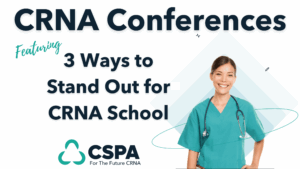
You’ve got the GPA. You’ve got the ICU experience. But deep down, you know it’s going to take more than that to rise above the tough CRNA school competition.
Here’s the truth most CRNA applicants miss: admissions committees aren’t just admitting students—they’re investing in future leaders of nurse anesthesia.
So how do you prove you’re one of them?

It’s not about having the fanciest experience or the perfect résumé. It’s about showing up in ways that reflect your dedication, initiative, and heart for this profession.
Whether you’re attending a CRNA conference, mentoring new nurses, or volunteering in your community, these are the quiet signals that tell a program: This applicant is ready.
If you want to strengthen your CRNA prep beyond the numbers—and finally feel like you’re doing enough—this guide will show you exactly where to start.
Last Updated: December 31st, 2025
Join the Free CSPA Community!
Want to Stand Out for CRNA School? Add These Three Things to Your CRNA Prep
When it comes to CRNA school, GPA and ICU experience matter—but they’re not the only things admissions committees are looking for. In fact, one of the best ways to stand out in a competitive pool of applicants is to show that you’re already acting like a leader in the profession.
If you’re wondering how to boost your application and stand out beyond the numbers, here’s a secret: get involved. Leadership, committee participation, volunteering, and attending CRNA-focused events (CRNA conferences) show programs that you’re invested in your growth and committed to contributing to the future of anesthesia.
Whether you’re early in your journey or already prepping to apply, here’s how you can build a stronger, more well-rounded application—starting now.
1. Attend CRNA Conferences
CRNA conferences are one of the most underrated ways to grow your confidence, build connections, and show programs that you’re committed to this path. They give you a front-row seat to what’s happening in the profession right now—and help you speak the language of anesthesia with more clarity and purpose.
Here are just a few options:
- AANA Annual Congress – The largest national gathering of CRNAs and SRNAs
- State and regional AANA conferences – Great for building local connections
- Your hospital system’s APRN/critical care conferences – Great places to grow your resume
And one we’re especially proud of:
🌟 The upcoming CRNA School Prep Academy In-Person Conference — June 2026 at the University of Louisville (KY)
This conference is designed specifically for CRNA school applicants. What makes it different?
- Hands-on simulation experiences that let you step into the role of a provider
- Educational workshops on pharmacology, ICU patho, interview prep, and more
- Emotional intelligence and its role in the interview, school and beyond
- Networking opportunities with current CRNAs, CRNA program faculty, and SRNAs who’ve walked the path
- A chance to connect with a like-minded community that gets the intensity of this journey
It’s not just an event—it’s a powerful investment in your future. And it signals to programs that you’re serious about becoming a CRNA—not just hoping to. This is crucial in the competitive admissions process!
Learn more about Gassed Up: Fired Up for CRNA School, The CSPA 2026 Conference here: https://events.crnaschoolprepacademy.com/
2. Step Into Leadership
You don’t need a formal title to lead. Leadership shows up in how you carry yourself, how you contribute, and how you support your team.
Here are some simple, meaningful ways to build leadership into your application:
- Precept new grads or travelers (and document it!)
- Join shared governance or a clinical council
- Volunteer to help onboard new nurses or orient staff
- Lead or participate in QI projects or safety initiatives
- Contribute to evidence-based practice reviews on your unit
If you’re already a member of a professional organization (like AACN, ENA, or your state nursing association), look into serving on a subcommittee—especially in areas like diversity, practice standards, or education.
Leadership isn’t about being the loudest voice—it’s about stepping up when it counts and showing you care about the bigger picture.
3. Volunteer With Purpose and Passion
Volunteering isn’t just a résumé booster—it reveals your heart for service. And in a profession built on trust, care, and advocacy, that matters.
Consider:
- Local opportunities like food banks, health fairs, or mentoring high school/college students
- Medical response teams like Maryland Responds or your state’s disaster health corps
- Specialty-aligned organizations like EMS/fire rescue, trauma outreach, or nursing coalitions
- Participating in community education, like stroke awareness or CPR courses
These experiences do more than fill a checkbox—they give you stories, confidence, and a deeper connection to why you chose this path.
And no! Your volunteer works doesn’t have to be in the medical field. One former CSPA student-turned-Nurse Anesthesia Resident had a passion for gardening, and she donated her crops to the local food bank!
This gave her something unique to talk about in her interview that allowed her to light up and shine— which is a great way to WOW the interview panel.
You Don’t Have to “Stand Out” Alone
The journey to CRNA school isn’t just about what you know—it’s about who you’re becoming along the way. And one of the best things you can do is plug into a community that supports, challenges, and reminds you that this dream is possible.
So yes—go to the conference. Say yes to that committee. Precept the new nurse. Apply for that leadership council. You never know how one experience, one conversation, or one decision might completely change your trajectory.
We hope to see you in Louisville in June 2026—ready to learn, connect, and take that next bold step toward CRNA school.
You’re not just preparing to apply. You’re preparing to lead.
Cheering you on!
Jenny Finnell, MSN, CRNA
Founder & CEO, CRNA School Prep Academy
PS if you’re ready for more connection, insight and growth opportunities with impact, join the Free CSPA Community!
ICU Dreaming About Anesthesia is our free online community- without the misinformation and negativity you may find elsewhere. Create a free account today to connect with fellow nurses, our team and CRNA faculty who are ready to support and guide you. Click here: https://www.cspaedu.com/community
Related Topics:
-
What’s the Best ICU for CRNA? Preferred ICU Experience for CRNA Admissions
-
CRNA School Costs: A Comprehensive Guide to Paying for CRNA School
-
CRNA School with a Low GPA + Programs That Look at Last 60 Credit Hours
-
Why Your CRNA School Interview Matters More Than GPA or Stats
Frequently Asked Questions:
1. Why should I attend a CRNA conference as a pre-CRNA student?
CRNA conferences give you direct exposure to the anesthesia profession. You’ll hear from faculty, current SRNAs, and practicing CRNAs while learning about emerging topics in nurse anesthesia. Attending shows initiative, helps you network, and gives you a competitive edge during interviews by allowing you to speak the language of the profession with confidence.
2. Do I need ICU experience before attending a CRNA conference?
Not at all. Many conferences, including the CSPA In-Person Conference, are beginner-friendly and designed for nurses at all stages of the CRNA journey—from pre-nursing to applying. These events can help clarify your goals and give you a head start in understanding what schools are really looking for.
3. What’s the difference between national, state, and school-specific CRNA conferences?
-
National conferences (like the AANA Annual Congress) offer a wide view of the profession and bring together CRNAs and SRNAs from across the country.
-
State and regional conferences are more intimate and often easier to attend locally, making it great for early networking.
-
School-specific conferences like the CSPA 2026 Conference are uniquely designed for applicants and include simulation labs, interview prep, and direct access to faculty.
4. How do I show leadership if I don’t have a formal role at work?
Leadership can look like precepting, joining a unit council, taking initiative on a QI project, or mentoring a new nurse. You can also get involved in professional organizations or volunteer for hospital committees. It’s not about titles—it’s about impact and initiative.
5. Will volunteering outside of healthcare still help my CRNA application?
Absolutely! Schools value applicants who show commitment to service and community—even if it’s not directly clinical. Unique volunteer work can help you stand out in interviews, demonstrate emotional intelligence, and reflect a strong sense of purpose. It also gives you meaningful stories to share.
6. I feel like I’m already doing a lot. Do I really need to add more?
Not necessarily. It’s about intentionality, not perfection. If you’re already strong academically and clinically, small additions like attending one conference or joining a local volunteer group can make a meaningful difference. Programs are looking for well-rounded candidates—not just resumes with a long list of activities.
7. How does the CSPA Conference help me stand out to programs?
The CSPA Conference is specifically tailored for aspiring CRNAs. It features hands-on simulation, expert-led workshops, and networking with faculty and current SRNAs. Attending signals to admissions committees that you’re serious, informed, and actively preparing—not just hoping—to succeed in CRNA school.
Important Links
Want Guaranteed CRNA School Admission? Learn More about the CSPA 12-Month Intensive Here: https://www.cspaedu.com/meblfkto
Get CRNA School insights sent straight to your inbox! Sign up for the CSPA email newsletter: https://www.cspaedu.com/podcast-email
Book a mock interview, resume or personal statement critique, transcript review and more: www.teachrn.com



0 Comments