 Back
Back
If you’ve ever watched a coworker get into CRNA school and thought, “Wait—how did they get in and I didn’t?” you’re not alone.
Every week, we hear from nurses who say things like:
“Someone I work with had a lower GPA.”
“They have less ICU experience than me.”
“They didn’t even have their CCRN—but they got accepted.”
Comparison is one of the hardest parts of this journey. It makes you question everything: Am I competitive enough? Did I choose the wrong schools? What do they have that I don’t?

The truth? Admissions isn’t a straight line—and it’s rarely “fair” in the way we expect it to be. Each program is looking for something slightly different, and sometimes, the timing just isn’t right yet.
But here’s what’s even truer: your story, your growth, and your persistence still matter—and they can absolutely change the outcome next time.
Let’s look at someone who proves that.
Casey Green, MSN, RN, now an RRNA at Rosalind Franklin University, faced seven rejections before her first acceptance. She’s also the 85th nurse in the U.S. to hold all five Emergency Nursing certifications—a milestone that represents extraordinary dedication.
However-
Even with that level of commitment, a stand-out application and resume, she still wrestled with doubt and had to overcome rejection again and again.
But she didn’t let comparison define her. She reframed rejection as redirection. And her story might be the one that helps you do the same.
Quick Overview
- Casey was rejected seven times without interviews—and still went on to earn two CRNA school acceptances.
- She became the 85th nurse in the U.S. to hold all five Emergency Nursing certifications, yet she still had to fight self-doubt.
- She chose positivity and persistence over discouragement.
- Her story proves that your passion and perseverance matter more than your GPA.
With mentorship, reflection, and focus, you can turn rejection into your next acceptance.
Join the Free CSPA Community!
The Story Behind the “No’s”
Casey had the credentials that most nurses dream of. Eight certifications. Four degrees. Years in trauma, critical care transport, and pediatric cardiac surgery. She was even a volunteer firefighter and disaster responder.
On paper, she was unstoppable. But on her first seven CRNA school applcations—nothing. Not even a single interview.
She remembers thinking, “If I have all of this experience and still can’t get in, maybe I’m not cut out for it.”
Sound familiar?
That’s the quiet part no one talks about—the emotional weight behind each rejection email. It’s not just the word “no.” It’s what your brain whispers afterward. Maybe I’m not smart enough. Maybe I waited too long. Maybe it’s time to let go.
But Casey didn’t.
Choosing Positivity When Everything Says “Quit”
Quick takeaway: You can’t control rejection—but you can control your response to it.
Casey made a conscious choice that changed everything: she refused to let negativity dictate her next step.
“Rejection isn’t the end of your story. It’s the beginning. It’s what you do when you face rejection that defines you,” she said.
And she lived that truth every day.
“I chose to keep plugging, keep applying, and keep being so happy for my friends getting in,” she said. “Because I knew my time was coming.”
That shift—from frustration to faith—moved her forward. Instead of comparing her journey to others, she celebrated theirs and learned from them. She focused on becoming the version of herself who would be accepted when her time came.
That’s not toxic positivity—it’s emotional endurance.
When you face multiple rejections, the goal isn’t to “think happy thoughts.” It’s to choose perspective over paralysis. Ask, “What can I tweak this round?” rather than, “What’s wrong with me?”
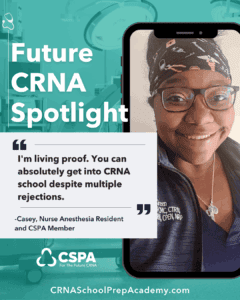
CRNA School Success: Casey Green, MSN, RN, also known as Critical Care Casey, overcame seven rejections before successfully gaining CRNA school acceptance. Her story is proof that resiliency pays off in the Nurse Anesthesia journey.
What Casey Did Differently
Bold truth: Rejection is feedback in disguise.
After her first few rejections, Casey didn’t keep hitting “submit” on the same application. She refined it—piece by piece.
- She looked beyond her GPA.
Her undergraduate GPA was 3.46- not bad, but not what most CRNA programs highlight. Instead of hiding it, she took action. She enrolled in an MSN program, earned a 3.9, and used that to show academic growth.
“You are more than your grades,” she reminded others. “Your accolades, accomplishments, and committee work will shine through.”
- She learned how to tell her story.
Programs don’t just admit grades—they admit people. Casey learned to communicate her “why” beyond her credentials: her love for patient care, her leadership in diversity and inclusion committees, and her years mentoring others in high-pressure environments.
“You are an inspiration to someone dreaming for the journey you’re on,” she wrote. “Your genuine passion for patient care and the profession will shine through.”
- She sought out mentors.
She credits mentors like CSPA’s own Jenny Finnell and Dr. Richard Wilson for helping her stay focused through rejection after rejection. Mentorship gave her perspective—helping her see where she could grow instead of focusing on what wasn’t working.
“I’m thankful for my mentors along the way that kept me focused and have been my rock on this journey that seemed rocky and impossible at times,” she said.
- She picked schools strategically.
Rather than throwing applications everywhere, she built a shortlist: schools that matched her learning style, location preferences, and professional goals. She looked for programs that would see her—not just her numbers.
“The school that is right for you will accept you,” she told others. “Keep your head up and enjoy the journey.”
- She stayed connected to her purpose.
Between ankle surgeries and full-time nursing, she could have quit. But she didn’t. “Rejection isn’t the end of your story,” she said again. “It’s the beginning.”
When the Acceptance Finally Came
After two years of recalibrating, Casey finally received the news she’d been working toward.
When she shared her announcement inside the CRNA School Prep Academy community, she wrote:
“Please allow me to reintroduce myself with my new four favorite letters: SRNA!”
That moment captured everything she’d fought for—perseverance, faith, grit, and heart.
She had earned her seat at Rosalind Franklin University’s Nurse Anesthesia program, and in doing so, proved something every applicant needs to hear: consistent growth beats instant success.
Her acceptance wasn’t a lucky break. It was the result of reflection, resilience, and relentless belief that her time would come.
Lessons You Can Borrow from Casey’s Journey
- Build a feedback loop.
After each rejection, get clarity: Was it GPA, ICU type, essay clarity, or interview readiness? Every “no” gives you something to fix for next time. - Don’t let comparison steal your focus.
Casey celebrated others’ wins while waiting for hers. That mindset kept her connected to the bigger mission: joining a profession, not winning a race. - Make mentorship your lifeline.
Sometimes you’re too close to your own story to see what’s missing. A mentor can spot gaps in your essay, coach you for interviews, and remind you that rejection doesn’t define you.
Re-evaluate your why.
Your application isn’t just a résumé—it’s your declaration. Programs want to see who you’ll be in the OR, not just who you are on paper. - Stay the course—but evolve.
Each reapplication should look stronger than the last. That’s how programs see resilience.
What Rejection Teaches You That Success Can’t
There’s a reason stories like Casey’s resonate so deeply: they remind us that resilience is a skill, not a trait.
When you get rejected, you learn to sit in discomfort, analyze without self-destructing, and rebuild confidence from the ground up.
You learn that success isn’t always fast—and that’s okay. The scenic route often gives you the best view.
Casey said it best:
“My journey included a lot of stops along the way and the scenic route a few times, but I wouldn’t have had it any other way.”
She’ll also be the first in her family to earn a doctorate—proof that persistence is powerful.
The Real Lesson: Your Story Isn’t Over Yet
If there’s one thing Casey’s story teaches us, it’s this—rejection doesn’t mean you’re not capable; it means you’re still becoming.
Every “no” you face is preparing you for a stronger “yes.” Every essay revision, every late-night study session, every conversation with a mentor—it’s all shaping the nurse and future CRNA you’re meant to be.
Casey’s path wasn’t straight, but it was hers. And yours will be too. Whether you’re on your first attempt or your fifth, your resilience is already proof that you have what it takes to thrive in this profession.
So take a breath. Reevaluate. Reach out for guidance or attend an upcoming Free Coaching Session.
Consider attending Gassed Up: Fired Up for CRNA School, the 2026 CRNA Conference hosted by CRNA School Prep Academy at the University of Louisville. It’s a weekend filled with actionable insights, networking with program faculty and the clarity you need to gain that “Yes!” acceptance. Learn more here: https://events.crnaschoolprepacademy.com/
Then get back up—because your story isn’t over. In fact, it’s just starting to get good. Can’t wait to see what you do next, Future CRNA!
Jenny Finnell, MSN,CRNA
Founder & CEO, CRNA School Prep Academy
FAQs
Q: What should I do after getting rejected from CRNA school?
Take a short break to regroup. Then request feedback if available, update your résumé, and meet with a mentor. Don’t rush to reapply with the same materials.
Q: How many times should I reapply?
As many as it takes—if you’re improving each time. Casey applied eight times. Growth between attempts matters more than the count.
Q: Does my GPA disqualify me?
Not automatically. Programs look at trends. If your undergraduate GPA is lower, consider graduate courses to show improvement—just like Casey did.
Q: Do I need multiple certifications like Casey?
No. One or two relevant ones (like CCRN or CSC) are enough. Casey’s “super-certified” path was unique, not required.
Q: How can I stay motivated through rejection?
Keep your “why” visible—write it on your phone wallpaper if you have to. Connect with peers who understand the process. And remember, rejection isn’t a reflection of worth; it’s an invitation to refine.
Key Takeaways
- Rejection is redirection. Every “no” helps you get clearer about where you’re meant to go.
- Your stats don’t tell your whole story. Programs accept passion, growth, and authenticity as much as GPAs.
- You’re not behind—you’re becoming. Whether you’re on your first or fifth attempt, you’re learning the qualities that make incredible CRNAs: resilience, empathy, and endurance.
Related Topics
What Is A CRNA? How Do You Become A CRNA? Plus CRNA Salary Information and the Top 10 Best CRNA Programs! – Learn what CRNAs do, how to become one, and what salary and program details matter most before applying.
CRNA School Cost: A Comprehensive Guide to Paying for CRNA School — Explore realistic costs and financing options for future CRNAs.
How to Find a CRNA to Shadow + Questions to Ask When Shadowing a CRNA — Get the CRNA Shadowing experience you need for CRNA school requirements plus learn what to ask the CRNA during your shadowing experience
Why Your CRNA School Interview Matters Most – Discover why your interview can make or break your CRNA application and how to stand out when it counts.
CRNA School Competition: How Hard Is It To Get Into CRNA School? – Understand what makes CRNA admissions so competitive and how to rise above other applicants.
The Best ICU Experience for CRNA Admission Requirements – Find out which ICU specialties CRNA programs prefer and how to make your experience stand out.
Written by Jenny Finnell, MSN, CRNA, founder of CRNA School Prep Academy
Important Links
Get CRNA School insights sent straight to your inbox! Sign up for the CSPA email newsletter: https://community.crnaschoolprepacademy.com/email-sign-up
Book a mock interview, resume or personal statement critique, transcript review and more: www.teachrn.com


0 Comments