Back
Back

Join the Free CSPA Community!
Join the Free CSPA Community! Connect with Aspiring CRNAs, Nurse Anesthesia Residents, practicing CRNAs, and CRNA Program Faculty Mentors who are ready to support you. Get real answers and expert guidance in a welcoming space that’s free from misinformation and negativity. You don’t have to do this alone! Join Now: https://www.cspaedu.com/community

Get access to application & interview preparation resources plus ICU Educational Workshops that have helped thousands of nurses accelerate their CRNA success. Become a member of CRNA School Prep Academy: https://cspaedu.com/join
Get CRNA School insights sent straight to your inbox! Sign up for the CSPA email newsletter: https://www.cspaedu.com/podcast-email
Book a mock interview, resume or personal statement critique, transcript review and more: www.teachrn.com
—
Watch the episode here
Listen to the podcast here
Cardiogenic Shock: Real-World Clinical Insights for ICU Nurses and SRNAs
Welcome back to the CSPA Podcast! I’m so glad you’re here. Today we’ve got a special episode for you featuring two incredible voices in critical care and nurse anesthesia: Dr. Richard Wilson, DNAP, CRNA and Nicole Kupchik, MN, RN, CCNS, CCRN-CMC, PCCN—a nationally recognized critical care educator known for her CCRN review resources and practical bedside insights.
This episode was recorded live at the 2025 NTI Conference in New Orleans, so you’ll notice a more informal, real-time format—and a bit of conference ambiance in the background. While I’m not hosting this one directly, I’m thrilled to share this important conversation with you.
So whether you’re a current ICU nurse, SRNA, or CRNA looking to sharpen your understanding of cardiogenic shock, you’re in the right place. Let’s jump in.
—
Hey, everybody. Richard Wilson here with CRNA School Prep Academy. Glad to have Nicole Kupchik here. Thanks for joining us.
Thanks for having me.
We’re both here at NTI 2025, and many of you know Nicole from her CCRN prep material, so we’re excited to have her. We’ve got a great topic for you today; we’re talking about cardiogenic shock. So I know this is one that a lot of you are interested in, as you’re working in the ICUs, you probably take care of a lot of patients that have that. So tell us a little bit about the pathophysiology behind it.
Cardiogenic Shock Pathophysiology
I think one of the things you’ve always got to think about when you’re caring for a patient with cardiogenic shock is number one, early recognition and that’s been a major issue. A lot of times patients are found when they’ve already got elevated lactate levels or already starting to have secondary organ injury And it’s truly, it’s important to back things up and identify much earlier than that.
There’s things that we can look for. Like, for example, do they have an S3 heart sound as a sign of fluid overload? You know, are they starting to develop crackles? Do they have knee mottling?
It’s actually a validated tool where you start at the knees and look above and below the knees to see how far they’re mottled. And if you’ve got mottling up into the mid thigh fold of the groin or above the groin, you’ve got a patient who’s in a lot of trouble. Are they urinating? Are they mentating? So looking for those subtle signs and symptoms are going to be really important.
Number two, I would say is you have to understand the the ideology of the cardiogenic shock. That is so important. And for example, your heart failure patients who exacerbate, who are hypotensive, that’s actually cardiogenic shock. If you have a patient with an anterior septal lateral wall MI, for example, that is a patient who’s at massive risk for cardiogenic shock.
So it’s all again, it’s always identifying, like, what that etiology is. Is it a septic patient who now is deteriorated and is in cardiogenic shock, you know. So going back to, like, the why are we in this situation, and then treatment from that point may vary a little bit.
So when we talk about really looking at cardiogenic shock, one thing to remember is just really pretty simple. It’s just going into heart failure, as you mentioned there. And we’ve got to think about when these patients come in, you know, all the stress they’ve been underneath, whether it’s a trauma patient, whether it’s a medical patient, all the stress, the heart’s been in during all of this situation.
Now we were just talking shortly before coming on here, and you were sharing with us that there’s some new guidelines and some of the new treatment of this. Share this with us.
SCAI Classification and Mechanical Circulatory Support
So there’s a group called SCAI and they, it was about three years ago, put out basically stages of cardiogenic shock and they tie the stages with what you’re seeing physiologically and then of course the hemodynamics in the shock state. And, and again, they focus so much on early recognition.
But, you know, when you look at the mortality of cardiogenic shock, you’ll see stats for mortality anywhere from, like, thirty to fifty percent or forty to sixty percent. Regardless, it’s high. I mean, can you imagine if you had a fifty fifty chance of making it out of the hospital because you’re in a shock state. Those are not stats I’d want to face.
Exactly.
And so truly, you know, recognition is going to be a cornerstone, but they’ve done evaluations looking at different mechanical circulatory support devices, and really it seems like the Impella is the winner. You know, there’s two different sizes of Impella for the left ventricle to help offload that left ventricle, and the size that gets inserted depends on, you know, basically what is the patient’s hemodynamic status.
Balloon pumps for cardiogenic shock have not really been shown to be overly favorable. They augment the cardiac output about a half a liter to one liter a minute. Where we’re using more balloon pumps now is for exacerbated heart failure for afterload reduction or, like, if we’ve got a patient with a left, like, with left main disease who’s gonna go for CABG, we might put a balloon pump in that patient to help with coronary perfusion.
And then VA ECMO, really where the data stands right now is we’re using it for patients who are absolutely crashing with cardiogenic shock. But really Impella seems to be kind of the sweet spot for technology and mechanical circulatory support. A lot of that is driven by calculating what’s called the CPO or cardiac power output, which is a sign that your left ventricle is failing if it’s low. And it’s normal, air quote normal, would be greater than, like, .6 watts.
So, you know, if you’ve got a patient who’s below .6 watts, they’re likely on the road to needing some sort of a left ventricular assist device. And then PAPI is pulmonary arterial pulsatility index; that gives us an indication if the right ventricle is failing in which, you know, we do have right sided impellas, we’ve got right sided ventricular assist devices and things that we can use to treat the right side of the heart.
So, really, when you’re looking at the circulatory support, it really is about balloon pump just kind of being a little bit of an augmentation, maybe kind of a crutch to get you to a specific spot. The Impella device is really it’s more support and then ECMO really in your kind of emergency last ditch kind of efforts.
But really when we talk about that too is, obviously, these patients are critical patients. So they’re not just on mechanical support. They’re gonna also be on some kind of vasoactive agent that helps support that. Right? Pharmacology is important in that and understanding it. So, when you look at the support that these ICU nurses will be using for cardiogenic shock pain, What are some of those meds?

Cardiogenic Shock Treatment Strategies and Medication Choices
I would say for blood pressure support, for the most part, again, it’s been studied. Norepinephrine seems to be the winner. Norepinephrine gives a lot of alpha receptor stimulation, so you get that peripheral vasoconstriction, and you get a little bit of beta one. So that’s one of the benefits.
Now because of that beta one, you may see tachycardias, but I’ll be honest, sometimes you can see the reverse as well. You can see reflexive bradycardias. You know, you have to remember anytime you’re using a vasopressor, it causes your vessels to vasoconstrict, which is gonna increase their afterload and increase the workload of the heart.
So it’s always a trade off. The trade off being, I need an augmented pressure, which we’re hoping equates to flow, because really it’s all about blood flow. Right? But we’re hoping that higher pressure equates to higher blood flow to perfuse your vital organs. So it’s a big trade off when you use a vasopressor.
So speaking of that, and I know you’re probably gonna talk about some myotropic agents here in just a few, but, you know, on the vasopressor side of that, that’s important to remember because as we talk about that and we look at it, MAP does not always equal flow.
MAP just is pressure, and I think that’s something that we have to really consider. Which is the reason why when I was in the ICU twenty years ago or twenty five years ago, we used a lot of alpha one agents like phenylephrine and so forth. And we didn’t have as much levofed that we utilized.
But it’s important now thinking about that beta one kit. To think about perfusion versus just getting an artificial number of an increased MAP assuming that that’s leading to flow. So as we look at some of those other cardiogenic agents or cardiogenic shock treatment agents, you know, what are some of the others that you use?
So, as far as pressors, I’ll be honest, like, the use of vasopressin, you have to remember how it works. It’s an antidiuretic hormone. So it works on vasopressin one receptors to cause peripheral vasoconstriction, but it also says to the kidneys, hold on to sodium and water. And if you’ve got somebody who’s already overloaded because their left ventricle is failing, it may not be the best option in a lot of cases.
We may use low dose epinephrine, and epinephrine, the effects you get from it all depend on the dose you’re using. So at lower doses, you should get more of that positive inotropy. A lot of cardiac surgeons like to use low dose epinephrine, but the trade off there is the tachycardia that you see with it. I would say in general, phenylephrine is one of those things I don’t see very often in shock.
Anesthesia loves it. In fact, you’re a CRNA, I’ve got to tease you, you know, that you carry mystery unlabeled syringes of it in your pockets and post op pow pow, and you’re like, oh, their pressure’s better. You know? So but in shock, it’s one of those drugs that’s kinda challenging because it is a pure alpha, and you get just that peripheral constriction without much beta one. So I just don’t see it used a lot.
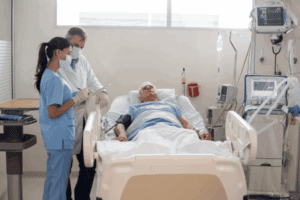
Cardiogenic Shock: At the bedside, as a CRNA, as a critical care nurse, it’s just important to understand how all the drugs work to best choose what you’re going to use in a different clinical situation.
And then as far as inotropes, dobutamine and milrinone, I would say, with low dose epinephrine, would be our our three main options. And Milnorone is- I love Milnorone. But, you know, one of the surgeons I work with always says, I love Milnorone, but you gotta invite her best friend, norepinephrine, because it causes so much vasodilation, which is good because that decreases afterload.
But the trade off is that patients may get hypotensive and the half life is about two and a half hours. So it’s got a long half life. Whereas dobutamine’s quick on, quick off. It’s a catecholamine. Two minute onset, two minute half life. But, again, because it’s a beta one, you see tachycardias with it. So I think at the bedside, as a CRNA, as a critical care nurse, it’s just important to understand how all the drugs work to best choose what you’re gonna use in a different clinical situation.
I will tell you, early in my career as a nurse anesthetist, I did use a lot of phenylephrine because that’s what we kind of got trained on. And it was in looking at a lot of recent studies, and over the years now, I’ve started transitioning into using a lot more levofed and norepinephrine, because of that beta kick that we get. And and like I said, now getting to be able to have flow and perfusion, on that.
Now one last thing that I wanna touch base with you as we talk about cardiogenic shock is, obviously, we’ve got the mechanical support that you were talking about. Most of these patients are already going to be on some kind of ventilatory support. We’ve talked about the pharmacology and the pharmacological therapy, but you cannot get away from fluid volume management also because it’s a heart. We have to look at preload. We’ve got to look at cardiac output.
One hundred percent.
So tell us a little bit, what are the studies showing, or the guidelines on, fluid volume management in these patients.
Well, you know, you would think these patients would need a ton of diuretics when they’re failing. But interestingly enough, you know, we see actually decent effects from lower dose Lasix. What you don’t want to do is give a whopping massive dose of Lasix, then all of a sudden you’re like, oh my gosh. They’re the shock is now worse. Right?
So a lot of times what we’ll do is we’ll titrate using, like, twenty milligrams of Lasix at a time and kinda see how the patient responds and then escalate as needed. As far as volume, you would have to remember when the right heart fails, it likes volume. When the left heart fails, it likes a diuretic.
And so it’s quite a dichotomy, you know, when you think about the two ventricles. I can’t say enough about the importance of using ultrasound and echo to actually look at the heart, look to see how the walls are moving, to really identify, you know, what would be the best therapy. Because the last thing you wanna do is volume overload, you know, a patient whose left ventricle is failing.
And the last thing you’d wanna do is diarice a patient who’s got right ventricular failure in the acute setting of hypotension. So, you know, it’s important. I think this is where ultrasound is just, it’s gotta be done in these patients, and you’ve gotta look at what the heart is looking like.
Which really, in which we look at it, we look at point of care ultrasound and doing TTEs, DEEs. We’ve got all of those technologies you can use. We’ve got the stroke volume variance monitors that can also be utilized.
Which I love. Yeah.
There’s a lot of things. So, Nicole, thank you for joining us. Of course. It was a pleasure seeing you again.
Great. Yeah.
We’re here again at NTI twenty twenty five. We’re excited, and have a great day.
—
Thanks so much for tuning in! We hope this conversation with Nicole Kupchik gave you fresh insight and confidence when it comes to understanding and responding to cardiogenic shock—whether you’re prepping for CRNA school, in clinicals, or already practicing in the ICU.
Want to dive deeper into related topics? We’ve got you covered:
Related Topics to Explore:
- ICU Cardiac Medications With Nicole Kupchik
- Pulmonary Artery Catheters: Hemodynamics And Case Management With Nicole Kupchik
- Phenylephrine (Neo-Synephrine): What Is It And How Does It Work? Free Study Guide Included!
- Epinephrine (Adrenalin): What Is It And How Does It Work? Free Study Guide Included!
- Norepinephrine (Levophed): What Is It And How Does It Work? Free Study Guide Included!
- What’s the Best ICU for CRNA?
Want more CRNA insights? Sign up for my FREE LIVE Webinar “Stand Out & Get In” to learn everything you need to know about getting into CRNA school.
Stay strong. We’re rooting for you, future CRNA!
Important Links
Join the Free CSPA Community! Connect with Aspiring CRNAs, Nurse Anesthesia Residents, practicing CRNAs, and CRNA Program Faculty Mentors who are ready to support you. Get real answers and expert guidance in a welcoming space that’s free from misinformation and negativity. You don’t have to do this alone! Join Now: https://www.cspaedu.com/community
Get access to application & interview preparation resources plus ICU Educational Workshops that have helped thousands of nurses accelerate their CRNA success. Become a member of CRNA School Prep Academy: https://cspaedu.com/join
Get CRNA School insights sent straight to your inbox! Sign up for the CSPA email newsletter: https://www.cspaedu.com/podcast-email
Book a mock interview, resume or personal statement critique, transcript review and more: www.teachrn.com